Albania: It's not just about flamingos – The protest has deep roots
Reclaiming patriotism from the nationalists, leaning on the diaspora, and the fear of organising beyond Tirana, in the struggle for the country's future.

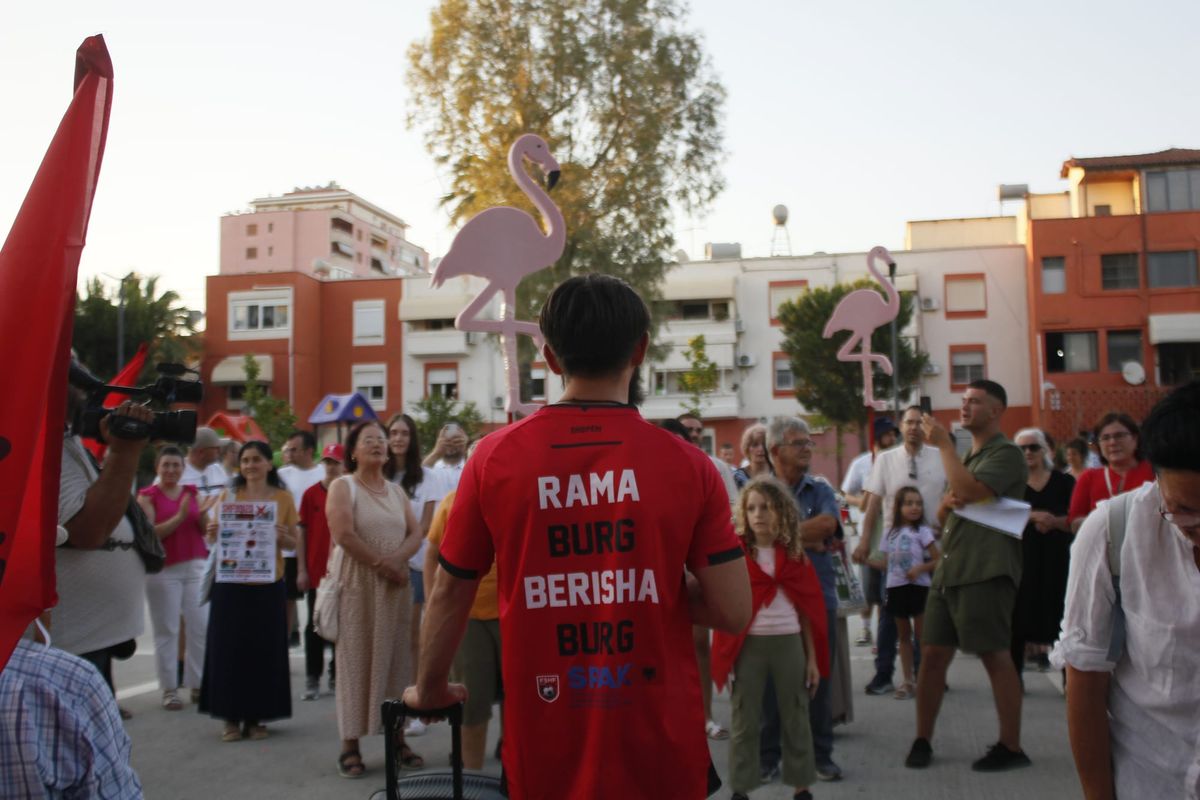
Editing and photos: Camillo Cantarano
Original text in Italian (at the bottom of the article), English translation provided through DeepL.
May 16 marked a turning point for me and for the activists in the Zvërnec area. We are located a few kilometers from Vlora, Albania’s third-largest city, in the southern part of the country. On May 16, the first protest took place, organized by local residents and volunteers working to protect the Narta Lagoon and the adjacent beach.
This area was designated a nature reserve until 2024 and has now become the focus of a massive speculative development project involving (among others) our Prime Minister Edi Rama, the Kastrati industrial group, and Donald Trump’s son-in-law and daughter, Jared Kushner and Ivanka Trump.
During that demonstration, clashes broke out with private security guards on the scene. Tensions escalated rapidly, and several citizens and a journalist sustained injuries. It was a traumatic event for the community of Vlora and for all of Albania, where the violence was compounded by a sense of being abandoned by politicians.
After that day, the protests did not stop. In the days that followed, new rallies were organized in Skënderbeg Square in Tirana, in response to the outrage over the events in Zverec. It wasn’t just activists: participation grew steadily and across the board.
Albania, an “inevitable” movement
For me, that first moment was decisive: I had the feeling that something was truly beginning to happen. Change could only come about if citizens—myself included—took responsibility.
My parents are Albanian, born and raised in the countryside near Vlorë. I, on the other hand, was born and raised in Italy. My whole life, I’ve been part of the diaspora: physically outside the country, but never far from it. I’ve always felt a strong connection to Albania, even from afar.
When I decided to move here two years ago, I immediately sensed that the country was at a crossroads, yet for some reason it remained stagnant. When I moved here, I was struck by the injustices and abuses against citizens: I couldn’t understand why there wasn’t a strong reaction to them.
Then came the events in Narta, where residents demanded that a natural area—known as a key stopover for flamingo migrations—be protected. The previous year, Jared Kushner and Ivanka Trump had finalized the purchase of Sazan Island, also a nature reserve, to transform it into an eco-resort for wealthy foreign tourists. The government had given away a sea turtle nesting site—one of the few remaining wild stretches of coastline around Vlorë—to do what? To build facilities that Albanians cannot afford and to distribute more wealth to friends and foreign investors.
When the first protest took place in Vlora against the construction of an airport and a resort owned by the petrochemical oligarch Kastrati and Kushner himself in the now-former Narta reserve, I felt I couldn’t just stand by and watch: too often, my city has remained silent in the face of speculative projects and injustices like this one. Taking an active part was necessary, almost inevitable.
How protests work
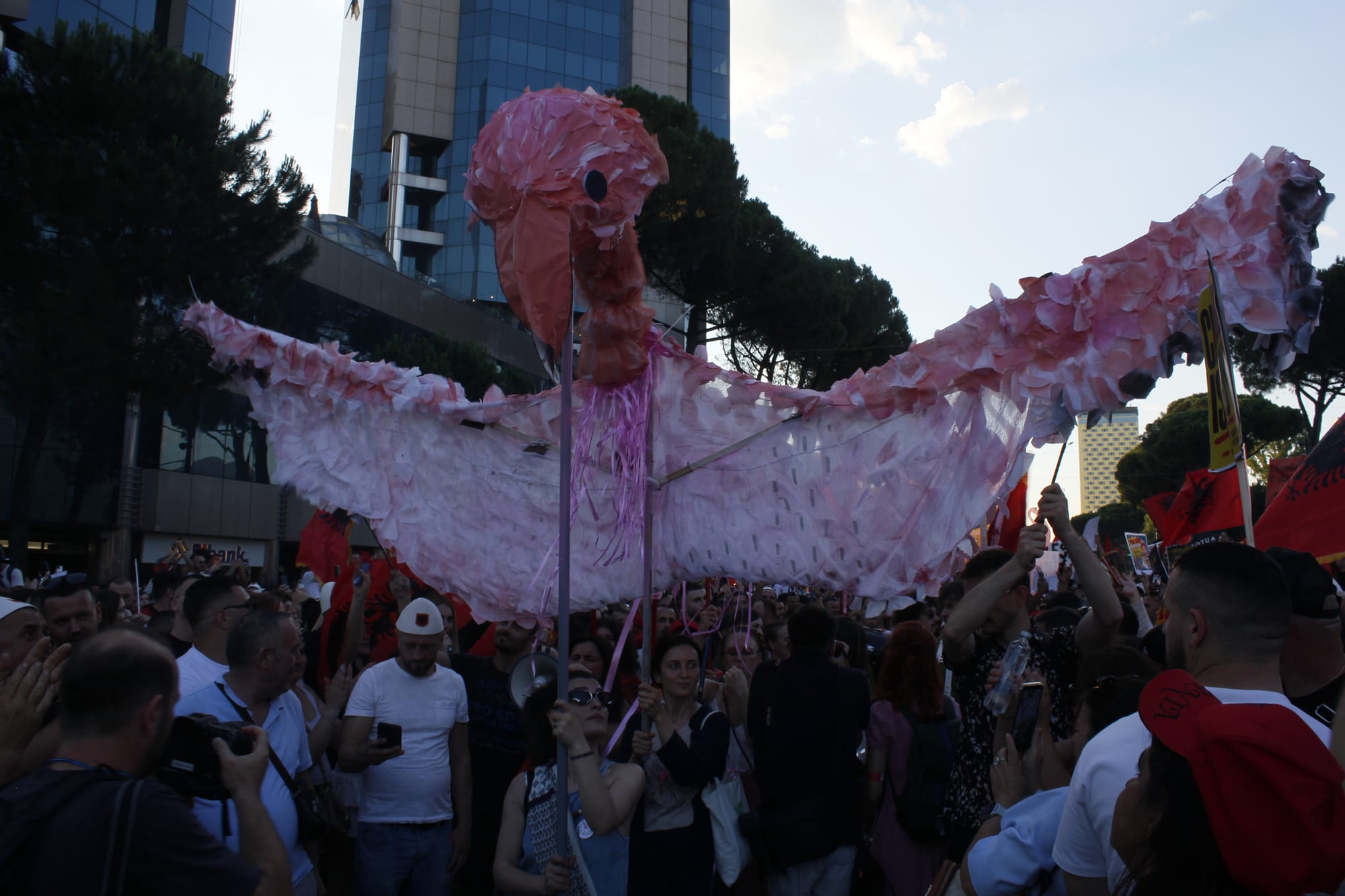
The first time I went to Tirana, I was expecting a simple protest: flags, chants, people marching through the city. In reality, I found something different: a collective experience rooted in community, unity, and participation.
The protests in Tirana follow a set “script”: they generally begin around 7:00 p.m. in Skënderbeg Square, where citizens gather before marching toward the Prime Minister’s Office. As I write this, we have entered the fourth week of continuous protests: every day, thousands of Albanians take to the streets. The peak so far was reached on June 21, when 250,000 people took to the streets on a hot summer night in Tirana.
The demonstration begins with speeches by the organizers, followed by a series of testimonials open to the public. This latter part is a massive collective ritual of sharing personal experiences and motivations. The diverse group of speakers fosters an exchange of ideas that is also beneficial to the movement.
Afterward, the protest continues with a march through the city center. The march begins around 10:00 p.m. and continues late into the night. Participants walk through the main streets chanting slogans related to the movement’s political demands. The protests continue indefinitely. The next day, the demonstrations resume.
There is also a space for families with children: to make it easier for young children to participate, a dedicated area has been set up where children can draw and color symbols and slogans, supervised by volunteers. This allows parents to take part in the protest.
Overcoming fear to move beyond Tirana
Although the results are clear, some critical issues remain. The first and most important is that the protests should have strong and widespread participation across the country, whereas at the moment they remain concentrated mainly in Tirana. Outside the capital, participation is much more limited. Even in Vlora—where it all began and which has a particularly passionate community of activists—turnout is low.
The lower number of young people outside Tirana is not a sufficient explanation. In talking with people, a fundamental obstacle has emerged: fear. Many citizens fear personal consequences: housing issues, financial penalties, or other forms of pressure such as threats or workplace harassment. Whether real or not, these fears are holding back the growth of our movement, especially outside Tirana.
The importance of listening and the role of the diaspora
For this reason, we organize informal meetings and discussion groups to try to motivate and reassure citizens. We combat fear by creating a space where people feel less alone. During these gatherings, people share not only political opinions but also personal stories.
I was particularly struck by a conversation with a woman in Tirana. She had lived in Canada for many years with her two children; she described that decision as difficult but necessary. She told me she had emigrated to give her family a future, because life in Albania was no longer sustainable. She added that she is back here today because she feels the country also needs the diaspora—those who left and can now help rebuild something. Her words were very clear: return, protect, and rebuild together.
A story similar to that of my own family: my parents, too, long bore the burden of those who leave and become part of the diaspora. Today, they plan to return to make their contribution. And so do hundreds of thousands of Albanian citizens abroad, who represent a vital part of my country’s energy: people who often left to study or look for work and went on to succeed. But they are also people with a deep sense of homesickness: reaching out to them and placing them at the center of our protest was essential.
Solidarity endures
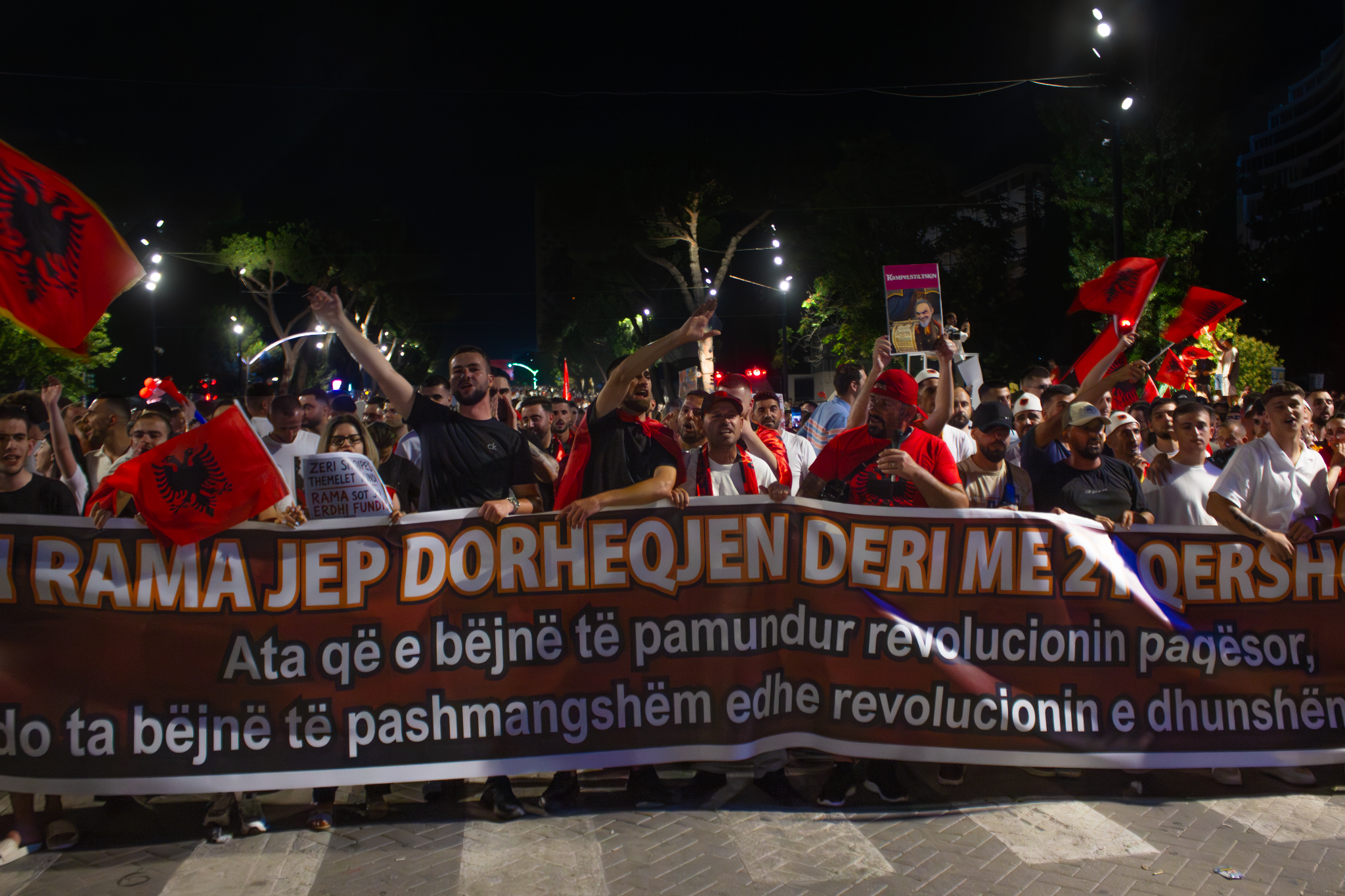
From these protests, I have learned that the values of brotherhood and unity are still strong among Albanians and come to the fore during difficult economic and social times like these. I have also changed my view of patriotism. For a long time, I associated it with external symbols, such as flags or images. But in a model of participation and looking toward the future like this one lies the “purest” form of love for Albania.
Albania is not alone in the fight against authoritarianism and governments perceived as corrupt or out of touch with their people: many countries, both within and outside the Balkans, are rising up against their political class. Albania is no exception, and our protest—which began as a fight for the environment—is rapidly transforming into a fight against corruption, for better working conditions, and above all to avoid being forced to migrate, which is the nightmare of these lands and their neighboring countries.
We are not willing to compromise
But all of this will be in vain if we do not first bring about a change in the current political class, represented by both Prime Minister Edi Rama and his main opponent (and former prime minister himself), Sali Berisha.
The media have labeled us the “Flamingo Revolution,” but I find this term limiting, given the breadth of our movement. Right now, struggles are intersecting for many reasons: the environment, the economy, freedom from the interference of foreign investment, and a paradigm shift at the political level. Albania is getting richer, but Albanians are not: the cost of living and rents are rising, while wages remain stagnant.
In this context, we do not feel represented politically: this is another reason why we have decided not to have leaders and to adopt a model of horizontal activism. In this way, we also protect ourselves from any interference by political parties. Looking back on the past month, I am convinced that we are getting closer to change. Stopping now would mean missing a once-in-a-lifetime opportunity for the Albanian people.